
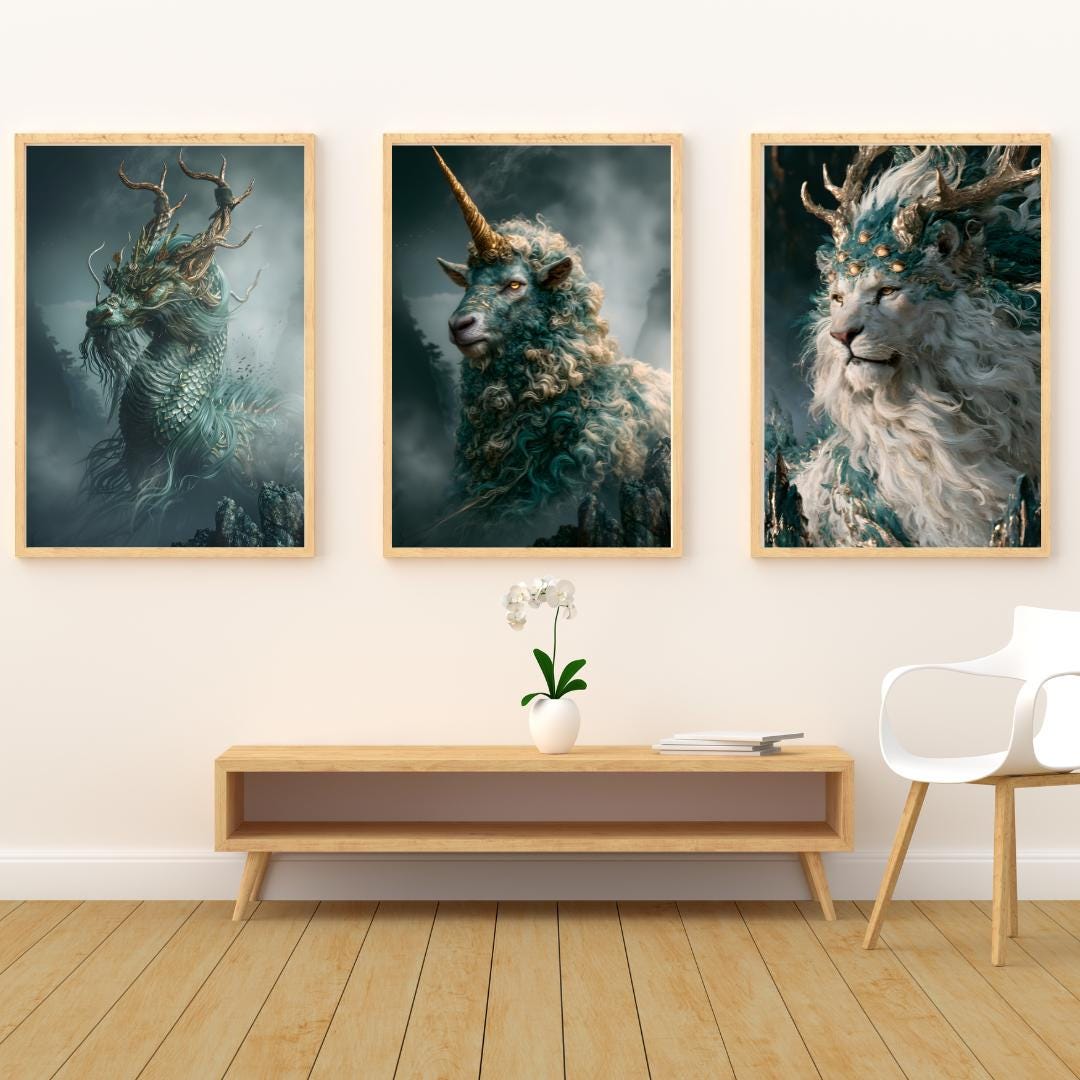
Most people who walk into our Halesowen training centre know the dragon, and plenty know the crane from Wing Chun’s own stories. Fewer have met the Qilin, the Bai Ze and the Xiezhi. These three creatures from Chinese mythology rarely turn up in films, yet each one carries an idea that sits very comfortably alongside martial arts training: kindness backed by strength, knowledge that keeps you safe, and the courage to tell right from wrong.
This post looks at what each beast stood for in the old stories, and what a student on the training floor can take from it. If you enjoy this kind of thing, you might also like our posts on cranes in Chinese mythology and the dragon and phoenix pair.
The Qilin: gentle power
The Qilin is often described in English as a “Chinese unicorn”, which undersells it. In the traditional stories it is a hooved, scaled creature that appears in times of peace or at the arrival of a wise and good leader. Its most famous quality is its gentleness. It is said to tread so lightly that it does not crush the grass beneath its hooves, and it will not harm innocent living things. Yet it is no pushover: it is also seen as a fierce protector when the good are threatened.
That balance is close to the heart of Wing Chun. We train to be able to protect ourselves and the people we care about, and the whole point of that ability is that it lets you stay calm, kind and patient in everyday life. A student who knows they can handle themselves has less need to prove anything. The Qilin is a good picture of that: real strength, carried lightly.
On the training floor, the Qilin shows up in small ways. It is the senior student who slows down for a beginner, the partner who gives you just enough pressure to learn from rather than to win, and the child who helps a younger classmate find their place in the line. Nobility, in the old sense, is about how you treat people.
The Bai Ze: knowledge that protects
The Bai Ze is a wise, talking beast. In the best-known story, it meets the legendary Yellow Emperor and describes to him the many spirits and strange creatures of the world, explaining what each one is and how to guard against it. The emperor has this knowledge recorded, and images of the Bai Ze were later kept as protective charms.
The lesson is a simple one: understanding is a kind of protection. A threat you can name and recognise is far less frightening than one you cannot.
That is very much how we approach self-defence. A lot of what keeps people safe happens before anything physical: noticing what is going on around you, spotting a situation that feels wrong, and knowing your options early. We wrote about this side of things in practical awareness tips for dark autumn evenings. In training itself, the Bai Ze’s spirit is in the questions. Why does this structure work? What happens if my elbow drifts off the centreline? Students who ask and understand tend to remember far more than those who simply copy shapes.
The Xiezhi: telling right from wrong
The Xiezhi is usually shown with a single horn. In the stories it could sense who was in the wrong in a dispute and would butt the guilty party with its horn. Because of this it became a long-standing symbol of justice and fair judgement in China, and its image was associated with officials whose job was to judge and uphold the law.
For martial artists, the Xiezhi is a reminder that skill needs a moral compass. Being able to strike is the easy part to explain; knowing when not to, and only ever using the minimum needed to get yourself safe, is the harder and more important lesson. Respect runs through the way our club is run, including respect for other styles and the people who practise them.
There is a quieter, personal side to the Xiezhi as well: honesty with yourself. When you practise Siu Nim Tao at home, nobody is checking whether your stance has crept up or your elbows have wandered. Telling yourself the truth about your own training, gently but clearly, is one of the habits that separates steady progress from years of going through the motions.
Three beasts, one set of values
Put the three together and you get a neat summary of what we hope students take away from their training, whatever their age:
- Qilin: strength used with kindness and restraint.
- Bai Ze: understanding, awareness and the habit of asking why.
- Xiezhi: fairness, honesty and knowing right from wrong.
None of these come from a single class. They build slowly, in the same way a stance or a punch does, through repetition and good example.
Bringing them into your training space
If these stories speak to you, our sister Etsy shop, TrackAndTrainStudio, has the Chinese Mythical Beasts Trio, a set of three teal and gold posters of the Qilin, Bai Ze and Xiezhi. The Qilin poster is also available on its own in the TrackAndTrainStudio shop. They suit a home training corner, a study or a bedroom wall, and make a thoughtful present for a martial artist who likes a bit of meaning behind their décor.
For more ideas on setting up the room you practise in, have a look at dojo wall art for your training space, or browse everything together on our prints and gifts page.
Come and train in Halesowen
Old stories are a lovely way into the values behind martial arts, but the real learning happens on the mat. If you live in or around Halesowen, you are very welcome to book a free trial class. You can see the full timetable on our Wing Chun classes in Halesowen page, or call, text or WhatsApp Sifu Alan on 07821 126 685.
Want more Wing Chun in your inbox?
Join the list for training tips and the occasional offer.
We’ll only email you what you’ve agreed to. Read our privacy policy. You can unsubscribe at any time.