
Watch a Wing Chun student run through Siu Nim Tao and there’s a moment where everything slows right down. One hand turns, circles and draws back towards the chest so slowly that it can look as if nothing is happening. That section is where you meet two of the most important hands in the system: Wu Sau, the guarding hand, and Huen Sau, the circling hand. Neither looks dramatic, but both turn up almost everywhere in Wing Chun.
What is Wu Sau?
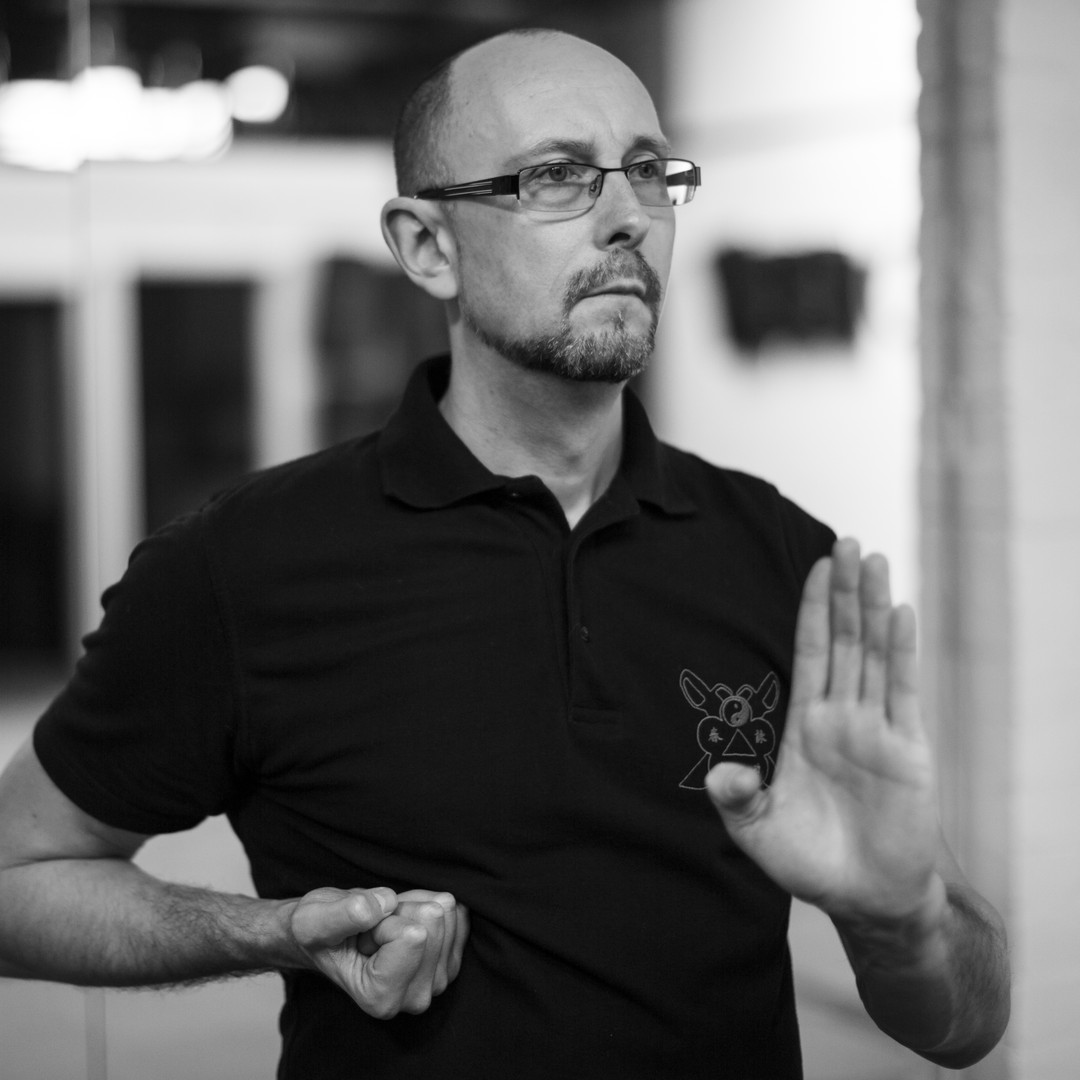
Wu Sau translates roughly as “protecting hand” or “guarding hand”. It’s an upright open palm held on your centreline, fingers pointing up, with the elbow down and in rather than flaring out to the side. The hand sits a comfortable distance in front of the chest, not pressed against it and not reaching out at full stretch.
In the Wing Chun guard, Wu Sau is usually the rear hand. The front hand (Man Sau, the “asking hand”) goes out first to meet whatever is coming, and Wu Sau waits behind it on the same line, ready to cover anything that gets past or to fire forward as a strike. If you’ve read our guide to Tan Sau, Bong Sau and Pak Sau, you’ll recognise the same idea: each hand has a job, and they work as a team rather than taking turns.
What is Huen Sau?
Huen Sau means “circling hand”. The wrist turns in a small, tight circle, so the hand rolls from one shape into the next without the arm pulling back or the elbow moving off its line. It’s a link rather than a destination. In Siu Nim Tao, Huen Sau is what carries Tan Sau into Wu Sau, and later in training it becomes the way you slip around an arm that’s blocking your path, or turn a deflection into a grab or a strike.
Because the circle is so small, Huen Sau is easy to do badly. Beginners tend to make it big and loose, swinging from the shoulder, or they bend the wrist so far that the forearm collapses. A good Huen Sau feels like turning a door handle: the movement is in the wrist, and the rest of the arm stays where it is.
The slow section of Siu Nim Tao
In the first form, Tan Sau, Huen Sau, Wu Sau and Fook Sau are linked together and repeated slowly, first with one hand and then the other. If you want the bigger picture of the form, our article Siu Nim Tao Explained walks through it. Here, it’s worth asking why this part is done so slowly.
The answer is the elbow. Wing Chun relies on what we call immovable elbow: the elbow stays on a line roughly a fist’s width in front of the body, and the hand moves around it. Doing the sequence slowly lets you feel whether the elbow is drifting out, whether the shoulder is creeping up and whether you’re tensing muscles you don’t need. Done quickly, those faults hide. Done slowly, there’s nowhere for them to go.
How the two hands work in practice
In partner work, Wu Sau is your safety net. If an incoming punch gets past your front hand, the Wu Sau behind it is already on the centreline, so it only has to move a short distance to cover. That’s far quicker than bringing a hand up from your waist.
Huen Sau earns its place when hands make contact. If your arm is pinned or your path is blocked, a small circle of the wrist can take you around the obstruction and back onto the line without pulling your arm back first. You’ll feel this a great deal in chi sau, where the hands roll constantly and small changes of angle matter far more than strength.
For adults, all of this is practised as applications: controlled partner drills where you apply the technique with a training partner at a pace you can manage. In the children’s class, the same hand shapes are taught in an age-appropriate way, and they feed into the controlled, supervised sparring the kids do.
Common mistakes and how to fix them
- The elbow flares out. Wu Sau should feel as though the elbow is gently sinking. If it lifts and pokes out to the side, the hand can be pushed straight back into your chest.
- The hand drifts off the centre. Wu Sau belongs in front of your sternum, not off to one side over a shoulder. Check it in a mirror.
- The circle is too big. Keep Huen Sau in the wrist. If your forearm is sweeping around, the circle is too wide and too slow.
- Too much tension. A rigid hand is easy to feel and easy to move. Stay relaxed and let the structure do the work, starting with a good Wing Chun stance.
- Rushing the form. If the slow section takes you ten seconds, it’s not slow. Give it time.
A simple practice at home
Stand in front of a mirror in your stance. Put one hand out in Tan Sau, then slowly circle the wrist into Huen Sau and draw the hand back into Wu Sau, keeping the elbow on its line all the way. Pause, check the elbow and shoulder, then push forward into Fook Sau and repeat. Five minutes a day, done carefully, is worth far more than half an hour of rushed repetitions.
Learn it properly in Halesowen
Hand shapes like Wu Sau and Huen Sau are much easier to get right with someone watching your elbow and correcting you as you go. At our training centre on Eagle Trading Estate, Stourbridge Road, adults train Monday to Thursday from 7:15pm to 8:15pm and on Fridays from 7:05pm to 8:05pm, and children aged 5 to 11 train Monday to Friday from 6:00pm to 6:55pm. You don’t need any experience or equipment, just comfortable clothes.
Your first class is free. Book your free trial class, have a look at our Wing Chun classes in Halesowen, or phone, text or WhatsApp me on 07821 126 685 if you’d like a chat first.
Want more Wing Chun in your inbox?
Join the list for training tips and the occasional offer.
We’ll only email you what you’ve agreed to. Read our privacy policy. You can unsubscribe at any time.